
Laboratory presses
Over 1,000 JOOS presses are currently in operation across the United States.
Lab Press for R&D and material testing
Developing innovative materials and manufacturing processes requires reliable testing under real production conditions. JOOS laboratory presses are engineered to support advanced material development and testing in research, sampling, product development, and industrial use. As a High Precision Press solution, these systems are designed for demanding testing applications where accurate temperature, pressure, and process control are critical. Engineered for repeatability, JOOS lab presses help manufacturers, universities, and R&D teams validate materials, tooling concepts, and production parameters with confidence before scaling to full production.
With more than 80 years of experience in German press manufacturing and over 40 years of experience serving customers in the U.S. market, JOOS is a proven manufacturer of custom-built laboratory presses, whose precision and long-term reliability are trusted by companies worldwide. As a manufacturer of hydraulic presses and a provider of custom solutions, JOOS develops advanced systems for research, testing, and specialized production environments. Whether you’re looking for a company to develop laboratory presses for a new project or an experienced supplier of laboratory presses—our engineering team is ready to support your application with custom solutions and proven German engineering expertise.
Laboratory Press Technology
- Press platen sizes up to 39.4″ × 39.4″
- Pressing force up to 600 tons
- Heated platen temperatures up to 842 °F
- Heating media options: water, thermal oil, or electric heating
- Fully adjustable process parameters: pressure, time, position, and temperature
- Force control range from 1–100%
- Low-maintenance hydraulic press system
- Heavy-duty machine design for long service life
- Advanced JOOS software for real-time process monitoring and data logging of critical parameters including pressure, temperature, position, and cycle time
- Custom-engineered press configurations available
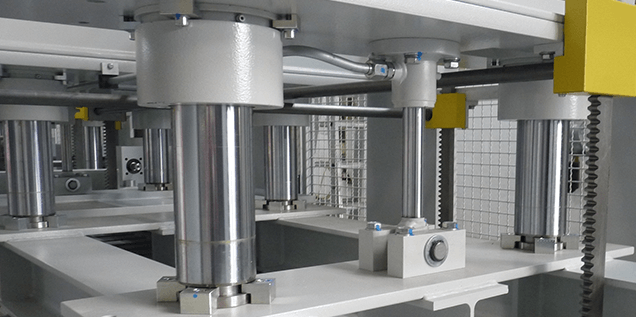
- Precision-machined solid steel heating platens with deep-hole drilling technology
- Engineered and manufactured in Germany
JOOS
Trust in the proven expertise of a manufacturer from the Black Forest, where JOOS has been developing high-precision presses for decades.
USA
JOOS USA, our service partner, provides direct support to customers in the areas of logistics, installation, and maintenance to ensure reliable operation and minimal downtime throughout the United States.
Two Hydraulic Press Series Designed for Scalable Testing and Production
Serie LAP M

LAP M Series: Powerful Performance for Advanced Laboratory Applications
The M Series delivers a powerful yet space-efficient R&D press system high pressure, engineered for more demanding applications and serving as a reliable pilot scale pressing system for advanced material development under controlled laboratory conditions.
Serie LAP
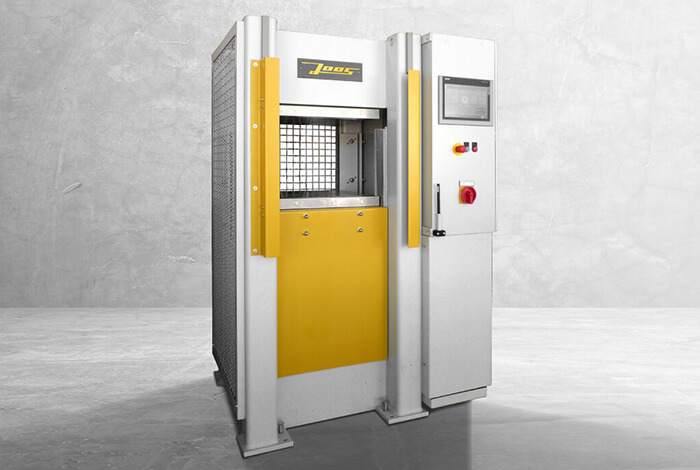
LAP Series Hydraulic Press: Full-Scale Flexibility for Advanced R&D and Lab Production
The LAP Series provides the full range of capabilities for laboratory and industrial use, functioning as a versatile lab scale production press that can be fully customized for complex testing, development, and high-performance pressing applications.


Laboratory Press Applications
Rubber and Elastomer Research
JOOS laboratory presses support the development and testing of rubber and elastomer products such as tires, seals, belts, and industrial components. Precise pressure and temperature control provide repeatable test conditions.
Wood-Based Materials and Sustainable Panels
Laboratory presses are used to develop adhesives, binders, veneers, films, and engineered wood products. They also support research into sustainable panels made from materials such as hemp hurds, rice husks, hop vines, and seagrass.
Medical and Dental Technology
JOOS presses can be used to develop and manufacture polishing and grinding tools for dental applications, as well as specialized medical and prosthetic components requiring controlled forming.
Orthopedic Applications
Laboratory presses support compression molding and thermoforming of orthopedic products such as custom shoe inserts and other components requiring precise pressure and temperature control.
Plastics and Polymer Research
JOOS lab presses are used to evaluate material properties and melt-flow behavior and to produce films, sheets, and test samples for product development and quality control.
Composite Materials
Laboratory presses support advanced material and composite research, including development of new structures and testing of mechanical properties under controlled conditions.
Why choose a JOOS laboratory press?
JOOS combines decades of engineering expertise with proven reliability in demanding applications. With over 80 years of experience in press manufacturing and more than 40 years serving the U.S. market, JOOS stands for precision, durability, and consistent performance. Every press is designed and manufactured in Germany’s Black Forest region, a place known for high-quality engineering and craftsmanship. This ensures you receive a lab press built to the highest standards, suitable for both standard and highly customized applications.
U.S. Service and Support
JOOS ensures reliable local support through its dedicated service partner JOOS USA, providing fast response times and on-site assistance. At the same time, JOOS itself remains the original press manufacturer, bringing deep expertise in custom press engineering and special-purpose press construction. This combination guarantees that customers benefit from both strong local service and direct access to the manufacturer’s engineering know-how.
Laboratory Press FAQs for R&D and Material Testing
Find answers to common questions about laboratory presses, material testing, custom press solutions, and advanced R&D applications.
What is a laboratory press used for?
Lab presses are used for material testing, sample preparation, prototype development, and process validation under realistic production conditions in laboratories. JOOS laboratory presses support R&D applications across industries including aerospace, automotive, plastics, rubber, wood processing, and advanced composites.
How does a hydraulic laboratory press improve testing accuracy?
Hydraulic lab presses provide controlled, even pressure throughout the pressing cycle. JOOS systems also control temperature, pressure, time, and position while recording process data in real time, supporting repeatable results and reliable process validation.
What should I look for in a laboratory hot press?
Key factors include pressing force, platen size, temperature range, heating technology, process control, and customization options. JOOS presses can use electric, water, or thermal-oil heating and can include multiple heating zones, data acquisition, and customized tooling.
Can laboratory presses be used for small-scale production?
Yes. In addition to material testing and R&D, JOOS lab presses can also be used for small-scale production of components and functional parts. Typical applications include smaller parts and products up to approximately 39″ × 39″ (1000 × 1000 mm).
How do laboratory presses support pilot production?
Laboratory presses allow manufacturers and research teams to test materials, tooling, and process parameters before full-scale production. They can simulate production conditions, optimize cycle parameters, collect process data, and reduce development risks.
Why choose a German-engineered laboratory press?
JOOS combines more than 80 years of hydraulic press manufacturing experience with advanced engineering and highly integrated production in Germany. Our presses are designed for precision, durability, reliability, and demanding laboratory and development applications.
All machines are built in accordance with applicable CE safety requirements.
What load and equipment options are available for a lab press?
JOOS lab presses are available with pressing forces from 5 to 600 tons, depending on the model and application. The equipment can include heated platens, multiple heating zones, hydraulic systems, adjustable process controls, and software for monitoring pressure, temperature, position, and cycle time. This allows you to select the right load range and equipment for material testing, research and development, and pilot production.
Choose your lab Press:
Compare our laboratory presses by force, pressure, and configuration
LAP M – Model Comparison
| Specifications | LAP M 5 | LAP M 10 | LAP M 10/1 | LAP M 20 | LAP M 20/1 | LAP M 30 | LAP M 30/1 | LAP M 40 | LAP M 40/1 |
|---|---|---|---|---|---|---|---|---|---|
| Pressing force (t) | 5 t | 10 t | 10 t | 20 t | 20 t | 30 t | 30 t | 40 t | 40 t |
| Press surface area (in x in) | 5.9 x 5.9 | 5.9 x 5.9 | 7.9 x 7.9 | 5.9 x 5.9 | 7.9 x 7.9 | 7.9 x 7.9 | 11.8 x 11.8 | 7.9 x 7.9 | 11.8 x 11.8 |
| Usable area (in x in) | 3.9 × 3.9 | 3.9 × 3.9 | 5.9 × 5.9 | 3.9 × 3.9 | 5.9 × 5.9 | 5.9 × 5.9 | 9.8 × 9.8 | 5.9 × 5.9 | 9.8 × 9.8 |
| Pressing room height (in) | 7.9 in | 7.9 in | 7.9 in | 7.9 in | 7.9 in | 7.9 in | 7.9 in | 7.9 in | 7.9 in |
| Spec. pressure with full load (psi) | 319 | 638 | 363 | 1,276 | 725 | 1,088 | 479 | 1,450 | 638 |
| Operating temperature (°F) | 482 °F | 482 °F | 482 °F | 482 °F | 482 °F | 482 °F | 482 °F | 482 °F | 482 °F |
| Operating Voltage (V) | 460 V | 460 V | 460 V | 460 V | 460 V | 460 V | 460 V | 460 V | 460 V |
| Weight approx. (lb) | 880 | 970 | 1,100 | 1,080 | 1,150 | 1,300 | 1,390 | 1,350 | 1,430 |
LAP – Model Comparison
| Specification | LAP 20 | LAP 40 | LAP 60 | LAP 80 | LAP 100 | LAP 150 | LAP 200 |
|---|---|---|---|---|---|---|---|
| Pressing force (t) | 20 t | 40 t | 60 t | 80 t | 100 t | 150 t | 200 t |
| Press surface area (in x in) | 19.69 × 19.69 | 19.69 × 19.69 | 19.69 × 19.69 | 19.69 × 19.69 | 19.69 × 19.69 | 23.62 × 23.62 | 23.62 × 23.62 |
| Usable area (in x in) | 17.72 × 17.72 | 17.72 × 17.72 | 17.72 × 17.72 | 17.72 × 17.72 | 17.72 × 17.72 | 21.65 × 21.65 | 21.65 × 21.65 |
| Pressing room height (in) | 15.75 | 15.75 | 15.75 | 15.75 | 15.75 | 15.75 | 15.75 |
| Spec. pressure with full load (psi) | 116.0 psi | 232.1 psi | 348.1 psi | 464.1 psi | 580.2 psi | 609.2 psi | 812.2 psi |
| Spec. pressure (11.8 × 11.8 in) | 319.1 psi | 638.2 psi | 971.7 psi | 1,290.8 psi | 1,609.9 psi | 2,421.8 psi | 3,219.8 psi |
| Operating pressure (psi) | 4,554.1 | 4,726.8 | 4,931.2 | 4,554.1 | 4,611.9 | 4,437.7 | 4,713.8 |
| Operating temperature (°F) | 482.0 | 482.0 | 482.0 | 482.0 | 482.0 | 482.0 | 482.0 |
| Operating Voltage (V) | 460 V | 460 V | 460 V | 460 V | 460 V | 460 V | 460 V |
| Weight approx. (lb) | 4,000 | 4,200 | 4,600 | 5,300 | 6,000 | 7,300 | 8,800 |
SET UP A CONSULTATION APPOINTMENT
We would be glad to offer you a thorough and non-binding consultation on our presses. Make your appointment now.
REQUEST AN OFFER
We would be glad to prepare a non-binding offer for you for one of our high-quality, high-performing presses.
REQUEST A BROCHURE
Request our brochure now, and learn more about our range of services and costumized equipment.